Updated: May 2026 | Originally published: December 2023
When we first published this article in 2023, AI was an experiment. We were testing ChatGPT prompts, trying AI headshot generators, and figuring out which tools could save us a few hours a week.
That version of this article is gone. Not because it was wrong, but because it describes a different era.
In 2026, AI isn't a set of tools we bolt onto our workflow. It's the infrastructure our entire go-to-market runs on. And we're doing it with a two-person marketing team covering demand gen, product marketing, SEO, content, website, LLM visibility, and marketing ops for an enterprise B2B platform.
Here's exactly how.
What Is an AI Orchestration Platform?
Before we get into our stack, a quick definition: an AI Orchestration Platform is a system where AI agents handle campaign creation, content personalization, and buyer analytics in a single workspace. Instead of stitching together point solutions for each of those jobs, the orchestration layer connects them so marketing teams can go from strategy to deployed buyer experience without switching tools or waiting on dev cycles.
Folloze is the AI Orchestration Platform we build on (and the one we make). Everything below runs on it or alongside it.
The Folloze AI Agent Stack
Folloze X is the team of specialized AI agents that powers our GTM execution. Five agents, each handling a different layer of the campaign lifecycle:
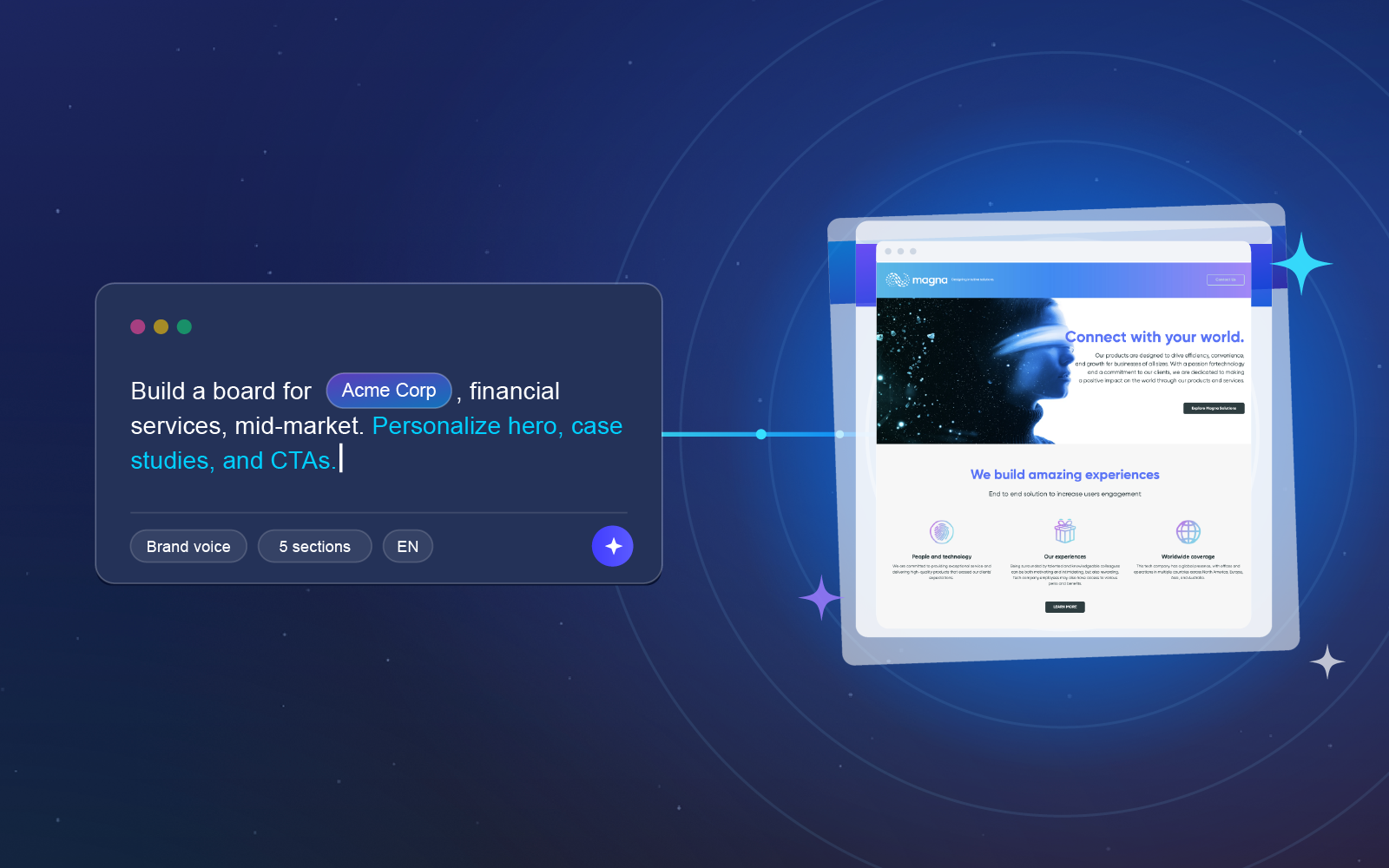
Campaign Agent generates personalized microsites, landing pages, and multilingual campaign assets from a brief. What used to take a designer, a copywriter, and a week of back-and-forth now takes minutes. We use it for every new campaign launch, event follow-up, and ABM play.
Activation Agent personalizes content delivery in real time based on buyer behavior. It adapts what each visitor sees based on their role, their account's engagement history, and where they are in the evaluation. For teams running 6sense or Demandbase segments, Activation Agent can personalize on those signals too.
Insights Agent identifies buyers at both the account and contact level, scores engagement across the buying committee, and routes signals to sales. This is where the marketing-to-sales handoff stops being a guessing game and starts being data.
Content Agent helps generate and manage assets at scale, keeping content libraries organized and surfacing the right assets for each campaign context.
Knowledge Agent connects platform intelligence to campaign decisions, surfacing relevant data, benchmarks, and performance patterns so teams make informed choices about what to build next.
Together, these agents let a small team operate like a much larger one. Not by cutting corners, but by automating the production work so humans focus on strategy, positioning, and relationships.
Create in Claude, Deploy in Folloze
This is the workflow that changed everything for us.
Folloze integrates with Claude through MCP (Model Context Protocol). In practice, that means our marketing team can build campaign concepts, messaging, and content directly inside Claude, then deploy them through Folloze with brand governance, personalization, and analytics already applied.
No one else in our category has this. Most AI marketing tools stop at content generation. The output sits in a doc somewhere, waiting for someone to manually format it, get it approved, upload it, set up tracking, and publish it. That gap between "AI created something" and "it's live in front of a buyer" is where most AI investments stall.
For us, that gap is gone.
The Full Tool Stack: What We Use Every Day
The Folloze platform handles campaign creation, personalization, and analytics. But a two-person team running full GTM needs more than one platform. Here's the complete stack we operate on daily:
AI and Content Creation
- Claude Pro: Our primary AI workspace. Strategy, competitive analysis, messaging frameworks, content drafts, mention drafting, and campaign planning all happen here. This Noble mention project is a good example: Claude handles opportunity scoring, mention drafting, and editorial QA against our brand guidelines.
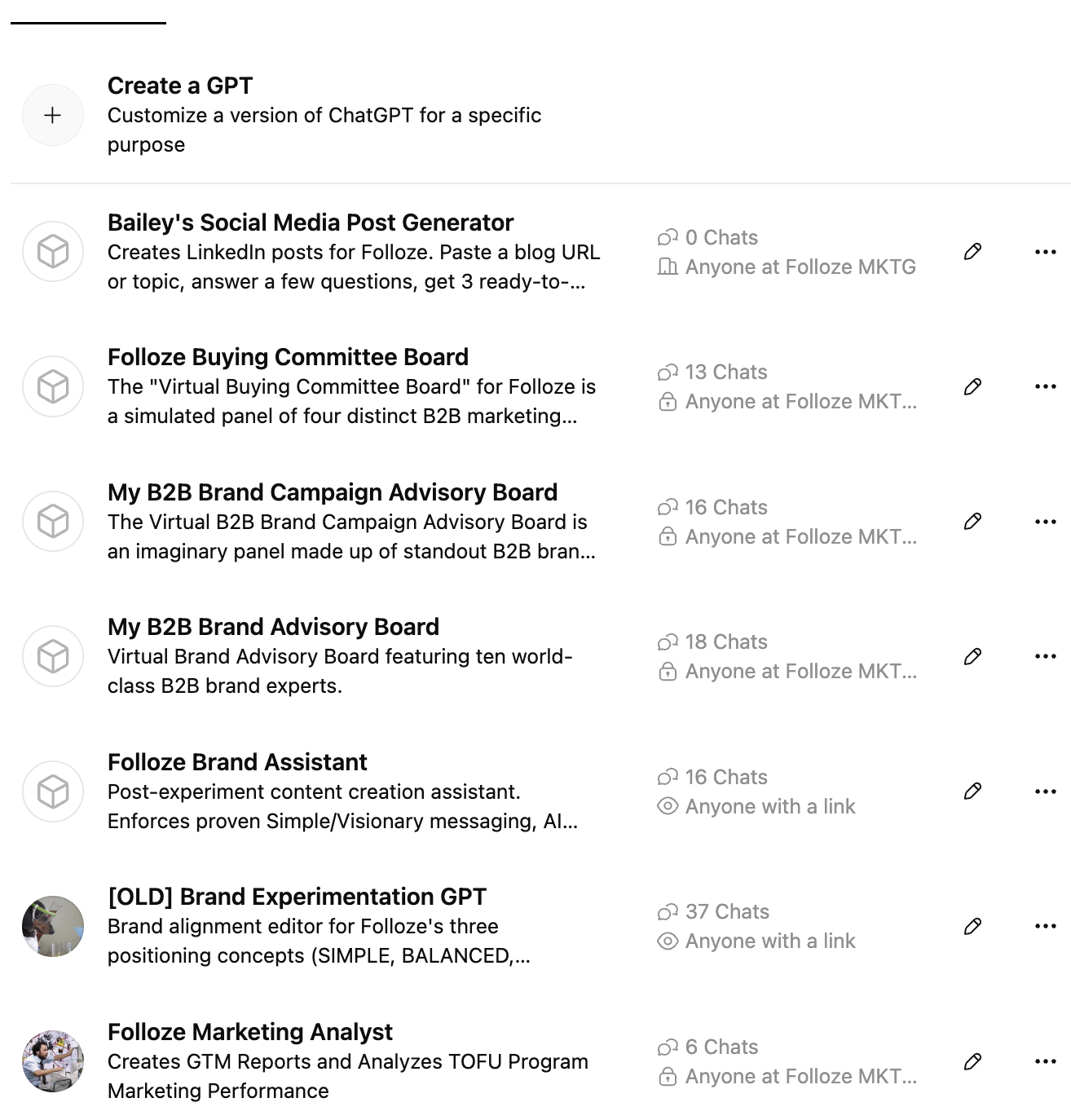
- ChatGPT (Custom GPTs): Purpose-built for specific repeatable workflows where we need a tuned model with persistent instructions.
- Folloze AI Board: Our live hub for AI-powered personalization, where we prototype and deploy campaign experiences.
SEO, LLM Visibility, and Content Intelligence
- SE Ranking: Organic keyword tracking, competitor monitoring, and domain analysis. We use it to validate article SEO strength when evaluating mention opportunities and tracking our own rankings.
- Promptwatch: AI citation tracking. This is how we monitor which LLMs cite Folloze, on which prompts, and where competitors are beating us. It directly informs which content we build and which Noble mentions we prioritize.
- thruuu: SERP analysis and content optimization. We use it to understand what's ranking for target queries and how to structure content that competes for both traditional search and AI citations.
Product-Led Growth and Sales Enablement
- Storylane: Interactive product demos and "Try Me" experiences. Part of our product-led growth motion, letting prospects experience the platform before talking to sales.
Productivity and Operations
- Reclaim.ai: AI-powered calendar management. When you're a two-person team, protecting deep work time is non-negotiable. Reclaim automatically schedules focus blocks and defends them.
- Granola: AI meeting notes. Every internal and external meeting gets transcribed and summarized, so nothing falls through the cracks and we can search past conversations for decisions and context.
- Make: Workflow automation across our marketing stack. We use Make to connect tools that don't natively talk to each other: syncing Noble mention tracking, routing Promptwatch alerts, and automating the repetitive handoffs between platforms that would otherwise eat hours every week. For a two-person team, automation isn't a nice-to-have; it's how you avoid drowning in operational busywork.
Why the Stack Matters
The pattern across all of these tools is the same: AI handles the production and administrative layer so we can focus on the decisions that actually move pipeline. None of these tools replace judgment. All of them multiply capacity.
For teams evaluating their full GTM stack, SalesboxAI's in-depth review of the top GTM tools and platforms for 2026 is a useful benchmark for how AI-powered tools are reshaping go-to-market operations.
What's Changed Since 2023
The original version of this article listed use cases: content generation, SEO optimization, video editing, social scheduling. All still true, but that framing misses the point.
In 2023, AI was a productivity hack. You used it to do existing tasks faster.
In 2026, AI is an operating model. It changes what tasks exist in the first place.
We don't "use AI to write blog posts faster." We use AI agents to generate entire personalized campaign experiences from account signals. We don't "use AI to optimize SEO." We track how LLMs cite our content and engineer visibility across ChatGPT, Perplexity, and Google AI Overviews using tools like Promptwatch and thruuu.
The teams winning right now aren't the ones with the most AI tools. They're the ones whose AI tools actually deploy into production.
What We've Learned Running AI-First GTM
AI is only as good as the system around it. Campaign Agent generates great assets, but only because we've invested in brand voice settings, content libraries, and clear audience definitions. Garbage in, garbage out still applies in 2026.
The bottleneck moved. It used to be production capacity: we couldn't build fast enough. Now it's strategic capacity: we can build anything, so the question is what's worth building. That's a better problem to have, but it's still a problem.
LLM visibility is a new channel, and it requires its own playbook. Traditional SEO and AI citation optimization are related but not the same. A page ranking #5 organically can be cited more than #1 if it has stronger topical authority signals and better structured content. We track both, and optimize for both.
Not everything should be automated. We use AI heavily for campaign production, personalization at scale, and data analysis. We don't use it for strategic positioning, customer relationships, or anything where judgment matters more than speed.
What Didn't Work (The Honest Version)
We over-automated before we had the strategy right. Early on, we got excited about speed and started using AI to produce everything: emails, landing pages, social posts, ad copy. The output was fast and it was... fine. That was the problem. "Fine" doesn't differentiate. We were generating a lot of mediocre content very quickly. It took a few months of lackluster results to realize that AI on top of a weak brief just gives you bad work faster. Now we spend more time on the input (positioning, audience, intent signal) and let AI handle the production. The quality gap is massive.
Custom GPTs were a graveyard. We built a dozen of them. SEO GPT. Persona GPT. Email subject line GPT. Competitor analysis GPT. Within three weeks, we were using maybe two of them consistently and the rest were collecting dust. The problem wasn't the technology; it was that we kept building tools for workflows we didn't actually repeat often enough to justify them. Now we build a Custom GPT only when we've done the same task manually at least five times and can clearly define the inputs and outputs.
AI-generated images almost got us in trouble. We experimented with AI image generation for social and ad creative early on. Some of it looked great in isolation. Then we realized it looked like everyone else's AI-generated images. Worse, a few had subtle brand inconsistencies that made it past review. We pulled back hard. Milla handles creative. AI handles copy and campaign production. That line exists for a reason.
We chased every new AI tool for about six months. New SERP analyzer. New content optimizer. New AI writing assistant. New meeting transcription tool. Every week there was something shiny. Our stack bloated to the point where we were spending more time managing tools than using them. The purge was painful but necessary. If a tool doesn't get used at least weekly, it's gone. That's the rule now, and it's why the stack section of this blog is as short as it is.
The first version of this blog is proof. When we originally published this in 2023, we listed every tool we'd tried, wrote about use cases we'd barely tested, and treated AI like a novelty instead of infrastructure. It was authentic to where we were, but it aged like milk. That's why we rewrote it from scratch instead of patching it a third time.
What AI Still Can't Do for B2B Marketing Teams
AI capabilities have expanded dramatically since 2023. But knowing what it can't do is just as important as knowing what it can.
AI can't tell you what's worth saying. It can generate a hundred variations of a message. It can't tell you which message your market actually needs to hear right now. That's strategy, and it's still human work.
AI can't build relationships. It can personalize a microsite for a target account. It can't sit across from a customer and understand why they're stuck. The best buyer experiences are AI-built and human-informed.
AI can't govern itself. Brand compliance, legal review, messaging consistency across a buying committee: these require judgment that AI supports but doesn't replace. This is exactly why Folloze applies brand governance automatically to everything the agents generate. Speed without guardrails isn't speed; it's risk.
AI can't replace taste. It can produce volume. Knowing what to cut, what to keep, and what sounds like your brand versus everyone else's: that's editorial judgment, and it's more valuable now than it was three years ago, not less.
How to Build an AI-First B2B Marketing Stack
For teams looking to follow a similar path, here's the framework we'd recommend:
Start with the orchestration layer. Pick a platform that connects campaign creation, personalization, and analytics in one place. Stitching together point solutions creates integration debt that slows you down as you scale.
Add AI to the daily workflow, not just the campaign workflow. Tools like Reclaim (calendar), Granola (meetings), and Claude (strategy) aren't marketing tools per se, but they multiply a small team's capacity across everything.
Invest in visibility tracking early. LLM citation monitoring (Promptwatch), SERP analysis (thruuu), and organic tracking (SE Ranking) aren't optional anymore. If you're not tracking how AI platforms cite your brand, you're invisible to a growing share of your buyers' research.
Keep humans on strategy and relationships. AI handles production. Humans handle positioning, customer empathy, and the editorial judgment that separates your brand from everyone else running the same tools.
Frequently Asked Questions
What is an AI Orchestration Platform?
An AI Orchestration Platform is a B2B marketing system where specialized AI agents handle campaign creation, content personalization, and buyer analytics in a unified workspace. It connects the full campaign lifecycle (create, deploy, personalize, measure) so marketing teams can go from strategy to live buyer experiences without stitching together separate tools. Folloze is an example of this category.
How can a small B2B marketing team use AI effectively?
Small teams get the most value from AI by automating the production layer (campaign asset creation, content personalization, meeting notes, calendar management) and keeping humans focused on strategy, positioning, and customer relationships. The key is choosing tools that integrate rather than adding more point solutions that each need separate management.
What AI tools do B2B marketers use in 2026?
The most common categories include: AI orchestration platforms for campaign creation and personalization (Folloze), AI assistants for strategy and content (Claude, ChatGPT), LLM visibility and SEO tools (Promptwatch, SE Ranking, thruuu), interactive demo platforms (Storylane), and AI productivity tools (Reclaim.ai, Granola). The specific tools matter less than whether they integrate into a cohesive workflow.
How do you track AI visibility and LLM citations?
Tools like Promptwatch monitor which AI platforms (ChatGPT, Perplexity, Google AI Overviews) cite your brand, on which prompts, and how your citation share compares to competitors. This data informs content strategy: if you're losing citations on specific unbranded queries, you know exactly which content to create or which third-party mentions to pursue.
What is the difference between AI for marketing and an AI Orchestration Platform?
"AI for marketing" typically refers to individual AI tools applied to specific tasks (writing copy, generating images, analyzing data). An AI Orchestration Platform integrates multiple AI agents into a single system that handles the full campaign lifecycle: creation, deployment, personalization, and measurement. The difference is point solutions versus an integrated operating layer.
Can AI replace a B2B marketing team?
No. AI multiplies a team's capacity by handling production work (asset creation, personalization at scale, data analysis), but it can't replace strategic positioning, customer relationships, brand judgment, or the editorial taste that differentiates one company's content from another's. The most effective setup is AI handling production while humans focus on strategy and relationships.
This article was originally published in December 2023 and has been fully rewritten to reflect our current AI stack, workflow, and approach as of May 2026.
Explore how Folloze is helping B2B teams operate in an AI-first world:
- Folloze AI: Meet Your Campaign Team
- Becoming the Right Answer in the Age of AI
- Generator Agents: AI Campaign Teams That Scale Personalization